
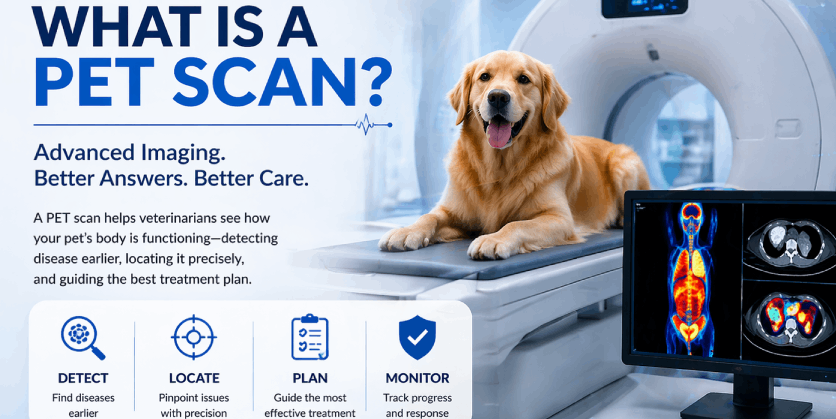
Ever been told your pet needs a PET scan and felt unsure about what it really means? When a doctor recommends advanced imaging, it is natural to feel a bit uncertain about what comes next.
Here is the reassuring part: understanding ‘What is a PET scan?’ It is simpler than it seems. It is a powerful tool that helps doctors visualize the pet’s internal body function, providing the clarity needed to diagnose and treat conditions effectively.
Whether you are preparing your pet for the first scan or trying to understand why this test was recommended, having the right information makes all the difference. This guide will walk you through everything you need to know, so you can move forward feeling informed, prepared, and confident about your next steps.
The Basics: What is a PET/CT Scan?
A PET/CT scan combines two advanced technologies into one highly precise imaging tool. But what does that really mean for you?
The PET (Positron Emission Tomography) component works like a metabolic tracker. It measures how active your cells are by observing their energy use. Since cancer cells grow quickly, they consume more energy, making them stand out clearly on the scan.
The CT (Computed Tomography) component, on the other hand, provides a detailed map of your body. It shows the exact structure, helping doctors locate organs and tissues with accuracy.
When combined, the results are powerful. The PET highlights abnormal activity, while the CT pinpoints its exact position. This is why many patients ask, ‘What is a CT PET scan?’ It is the combination of function and structure in one scan.
Today, PET/CT systems account for over 80% of PET imaging, making them the gold standard in cancer detection and monitoring.
What is the Difference Between a PET Scan and an MRI?
Understanding ‘what is a PET scan vs MRI’ gives you clear insight into why your doctor may choose one test over the other, depending on what they need to evaluate.
An MRI (Magnetic Resonance Imaging) works like a high-definition photograph. It uses powerful magnets to create detailed images of soft tissues, your brain, muscles, ligaments, and organs. MRI is excellent for identifying structural changes and abnormalities with great clarity.
A PET scan, on the other hand, works more like a live activity tracker. Instead of just showing what your body looks like, it reveals how it is functioning. Using safe tracers, PET scans highlight areas of high metabolic activity, often where cancer cells are growing and consuming more energy than normal cells.
So, what is the difference between a PET scan and MRI? In simple words:
- MRI shows the structure
- PET shows function
This difference is critical in cancer care. A tumor may appear small on MRI but highly active on PET, indicating aggressive disease. Meanwhile, scar tissue may look suspicious on MRI but show no activity on PET, suggesting it is harmless.
What are Radioactive Tracers?
Radioactive tracers are small amounts of safe, medical-grade material combined with substances your body naturally uses, such as sugar or proteins. Once injected, they travel through your bloodstream and are absorbed by cells.
Because cancer cells are more active and consume more energy, they take up more of the tracer. The PET scanner then detects this activity and creates clear images highlighting areas of concern.
The radiation exposure is low, similar to a standard chest CT scan, and the tracer naturally leaves your body within a few hours.
The Standard: What is an FDG PET Scan?
FDG PET scan is the most common type of PET imaging, used in approximately 74% of all PET procedures.
FDG stands for Fluorodeoxyglucose, essentially radioactive sugar. Since most cancer cells are metabolic gluttons that consume sugar at 10 to 20 times the rate of normal cells, they absorb the FDG and “light up” on the scan like bright spots against a darker background.
What is an FDG PET scan used for? Primarily detecting and monitoring most solid tumors, including lung cancer, breast cancer, colon cancer, lymphoma, and melanoma. It’s also valuable for evaluating brain function and heart muscle viability.
Prostate Focus: What is a PSMA PET Scan?
A common question many patients ask is, ‘What is a PSMA PET Scan?’ It’s an advanced imaging test specifically designed to detect prostate cancer with high precision.
This scan uses a specialized tracer that targets PSMA (Prostate-Specific Membrane Antigen), a protein found on prostate cancer cells. Once injected, the tracer binds to these cells, allowing them to appear clearly on the scan, even when they are very small or difficult to detect.
Because of its targeted approach, a PSMA PET scan helps doctors accurately locate cancer, assess its spread, and plan the most effective treatment strategy.
Neuroendocrine Focus: What is a DOTATATE PET Scan?
A question often asked is, ‘What is a DOTATATE PET Scan?’ It is a specialized imaging test used to detect neuroendocrine tumors (NETs) with high accuracy.
This scan uses a tracer that targets somatostatin receptors, which are commonly expressed on these tumor cells. Once injected, the tracer binds to these receptors, making the tumors clearly visible on the scan.
This precise targeting allows doctors to detect even small or hidden NETs that other scans may miss. As a result, DOTATATE PET scans play a vital role in early diagnosis, staging, and guiding effective treatment plans.
Preparing for Your Pet’s Specific Scan
Preparing your pet for a PET scan depends on the type of tracer used, and following the right steps ensures accurate results.
For FDG PET scans:
- Fast for 4-6 hours (water is okay)
- Avoid strenuous exercise 24 hours before
- Your blood sugar will be checked before the injection
- Expect to rest quietly for 60-90 minutes after tracer injection
For PSMA PET scans:
- Usually, no fasting is required
- Normal diet and medications
- Much simpler prep than FDG
For DOTATATE PET scans:
- May need to stop certain medications
- Your doctor will provide specific instructions
Always confirm specific instructions with your imaging center 24–48 hours before the appointment.
The scan itself takes around 20–45 minutes, though the full visit may last 2–3 hours. Your pet will lie comfortably on a table that moves through a quiet, open scanner, with trained professionals ensuring their safety and comfort throughout the process.
Take the Next Step in Your Imaging Journey
Choosing the right imaging test can make a real difference in your pet’s diagnosis and treatment. At BritVet Imaging, we offer advanced PET/CT scans with a team that understands how stressful it can be when your pet needs specialized care.
Whether your pet requires a standard FDG scan, targeted imaging for specific conditions, or advanced diagnostics for complex cases, we provide accurate results with a gentle, compassionate approach. Your pet’s comfort and safety remain our top priorities at every stage.
Have questions or ready to schedule your pet’s scan? Get in touch with BritVet Imaging today to speak with our specialists. We’ll guide you through the process and ensure you feel confident about every decision.
Your pet’s health deserves precision. Your peace of mind matters.
Frequently Asked Questions
Is the radiation from a PET scan dangerous?
No. PET scan radiation is low and safe, similar to natural background radiation over 2-3 years. The tracer leaves your body within 24 hours through urine.
Why did my doctor order an MRI instead of a PET scan?
MRIs show detailed soft-tissue structures, ideal for brain, spine, or joint issues. PET scans reveal metabolic activity, better for detecting cancer spread or treatment response.
How long does a PET/CT scan take compared to an MRI?
PET/CT imaging takes 20-45 minutes, but the total appointment time is 2-3 hours with tracer waiting. MRI takes 30-90 minutes with no waiting period required.